OK
I CAN STILL POST ON LARRY'S ACCOUNT
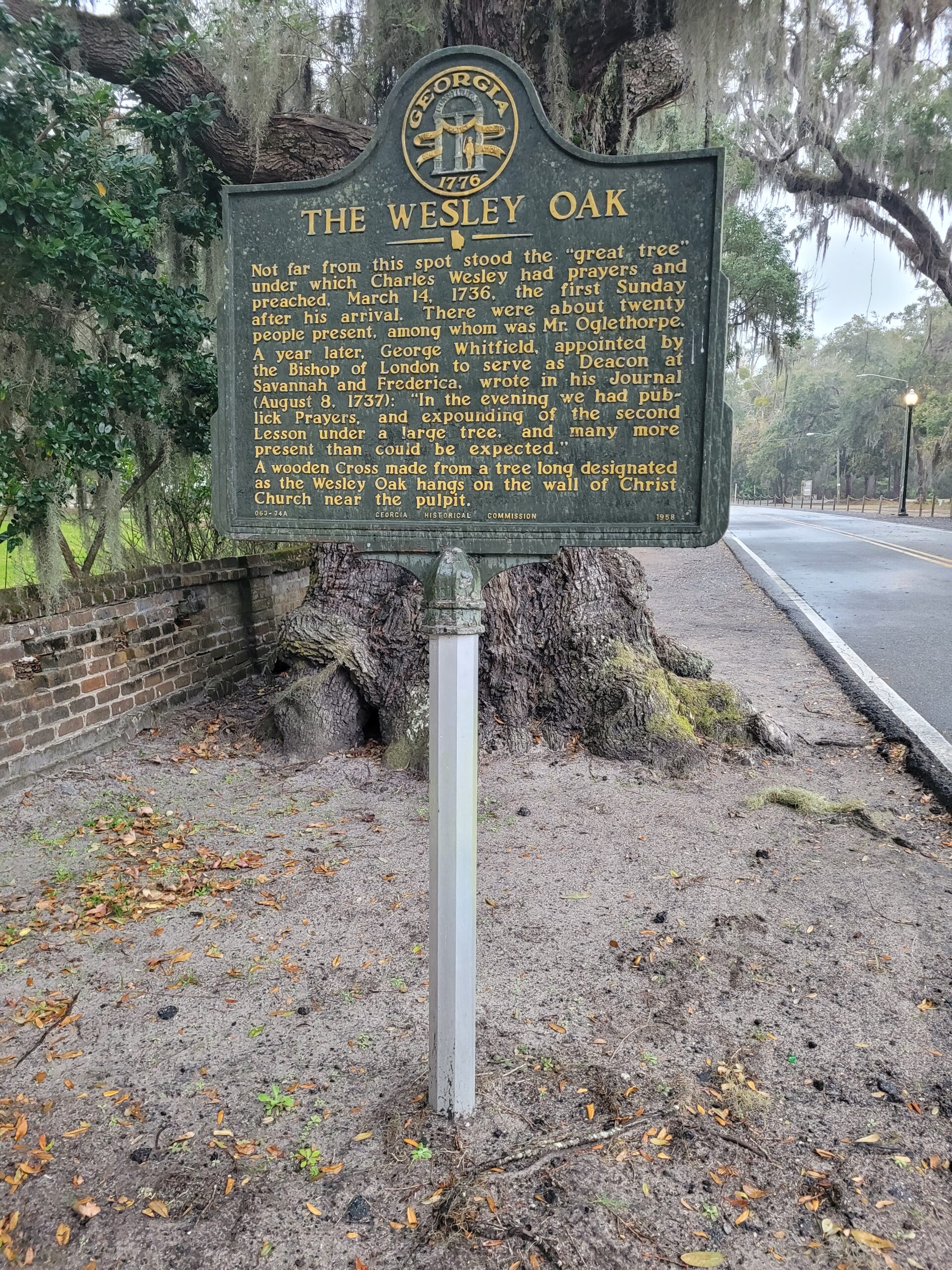
Charles Wesley set sail for Georgia on October 21, 1735 with his brother John who was doing missionary work for the Society for the Propogation of the Gospel in Foreign Parts. While John was assigned to be the minister at Savannah, Charles served as General Oglethorpe’s secretary of Indian affairs and minister to the soldiers and settlers of Frederica. He arrived on March 9, 1736 and recorded in his journal, “about three in the afternoon, I first set foot on St. Simons island, and immediately my spirit revived. No sooner did I enter upon my ministry, than God gave me, like Saul, another heart…”
When Charles arrived at Frederica he found very primitive conditions and he held services in the open and small prayer meetings in the temporary palmetto huts the settlers constructed. Preaching, however, was not his only job at Frederica. Seven days after his arrival he recorded in his journal, “I was wholly spent in writing letters for Mr. Oglethorpe. I would not spend six days more in the same manner for all Georgia.”
Wesley was constantly involved in the personal struggles of Frederica’s settlers and quickly earned James Oglethorpe’s disfavor. In his journal, he noted, “At half-hour past seven Mr. Oglethorpe called me out of my hut. I looked up to God, and went. He charged me with mutiny and sedition; with stirring up the people to desert the colony.”
At this point in his life, Charles lacked the physical, emotional and mental stamina needed to cope with such a difficult life on the Georgia frontier. While Charles had no love for the conditions in Georgia, many of the Georgia settlers had no great love for the Wesleys. To recent settlers struggling to survive on the harsh frontier, the immediate needs of safety and survival mattered far more than the strict piety espoused by both John and Charles Wesley.
On May 12, 1736, Charles left Frederica eventually bound for England. He recorded his feelings in his journal, “I was overjoyed at my deliverance out of this furnace, and not a little ashamed of myself for being so."
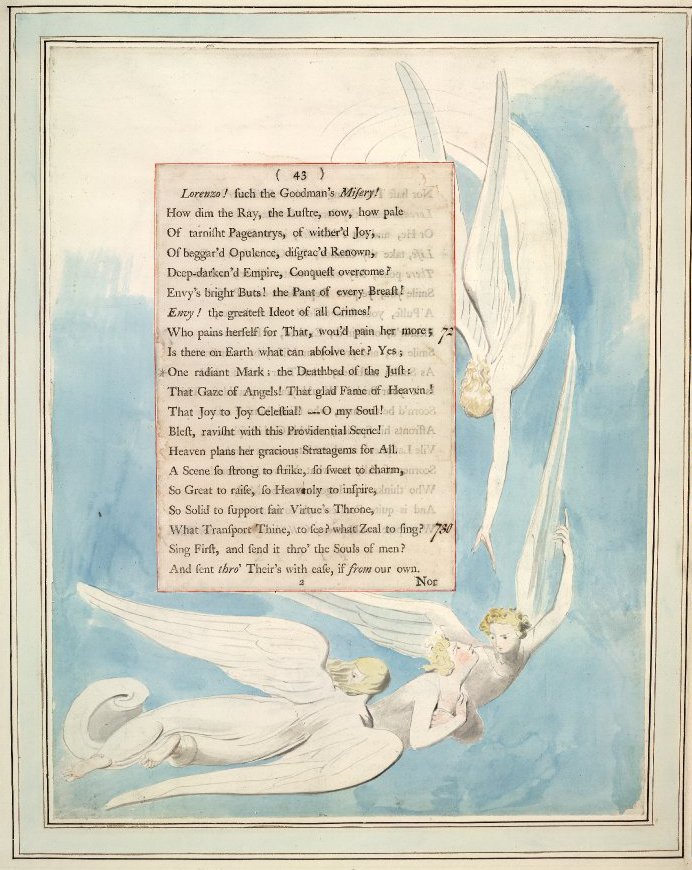
Hark! The herald angels sing by Charles Wesley

https://chapel.duke.edu/sites/default/files/offset-3.jpg

James Buchanan Duke, Duke Memorial Chapel
Charles Keck
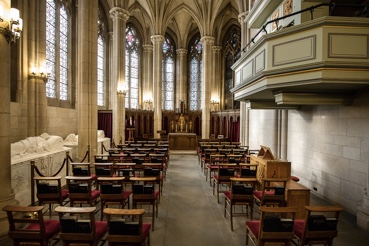
To the left of the chancel and behind the iron gates is the Memorial Chapel. On the altar are three limewood figures: St. Paul, Jesus, and St. Peter. Entombed in the Memorial Chapel are the benefactors for whom the University is named, Washington Duke and his two sons, Benjamin N. Duke and James B. Duke. The sarcophagi and the Memorial Chapel were gifts of the Duke Memorial Association.
Between the Memorial Chapel and the chancel, a flight of steps descends to the crypt. Here are buried the following people: William Preston Few, first president of Duke University; Mrs. Nanaline Holt Duke, wife of James B. Duke; J. Deryl Hart, fourth president of Duke University; Mrs. Mary Johnson Hart, wife of J. Deryl Hart; Terry Sanford, sixth president of Duke University, U.S. Senator, and governor of North Carolina; Mrs. Margaret Rose Sanford, wife of Terry Sanford; The ashes of James A. Thomas, chairman of the Duke Memorial Association; James T. Cleland, former dean of Duke Chapel; and his wife, Mrs. Alice Mead Cleland, are also interred here.
Charles Keck, sculptor

______________
Robert E Lee
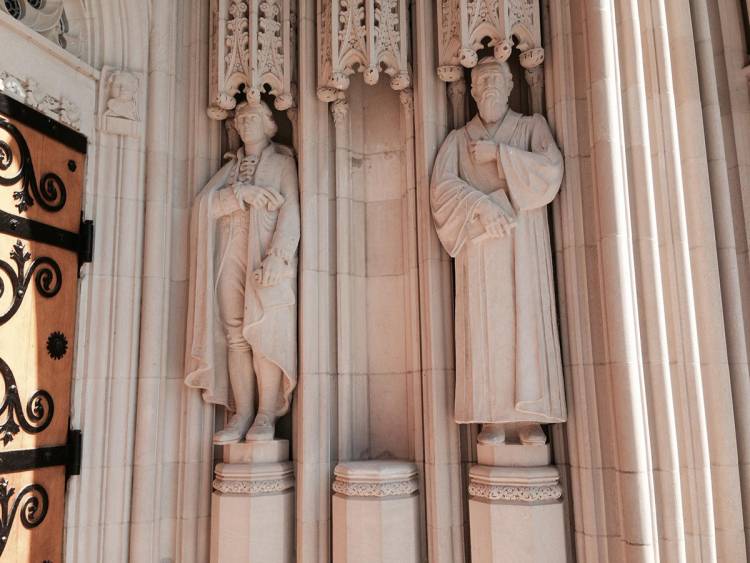

Video - 'God is the Imagination'
Seeing Kathleen reminds me of how Larry first discovered Kathleen Raine's Blake and Tradition
when he was in the sitting room of the National Gallery in Washington
DC waiting for me to finish looking at pictures. The Melons were
instrumental in envisioning and financing the museum and also sponsored
the publication of Raine's book. So that may explain why the book was
available there. After that we would sometimes go to the National
Gallery just so Larry could read the book, since our local Arlington
library didn't have a copy. One cold and rainy Saturday morning we went
to the museum but were disappointed - the sitting room was overflowing
with anti-war protesters who were looking for a warm spot to dry their
clothes and feed their babies. A friend who had a friend who had
borrowing privileges at the Library of Congress, borrowed the book for
us so that Larry could get a longer look at it.
https://droversgap.substack.com/p/the-fiddler-girl
Nobody played for money
And no one sang for pay,
We only loved the music
And gave our love away;
All who were there with us
Got caught up in our sound,
Dancing in the golden light
And passing love around.
Sing to the tune of O Susanna

