
March 5, 2022

I KNOW A GREEN CATHEDRAL
Gordon Johnstone and Carl Hahn
I know a green cathedral,
A shadowed forest shrine,
Where leaves in love join hands above
To arch your prayer and mine.
Within its cool depths sacred,
A priestly cedar sighs,
And the fir and pine lift arms divine
Unto the pure blue skies.
In my dear green cathedral
There is a flowered seat
And choir loft in branchéd croft
Where songs of bird hymn sweet.
And I like to dream at evening,
When the stars its arches light,
That my Lord and God treads its hallowed sod
In the cool, calm peace of night.
That my Lord and God treads its hallowed sod
In the cool, calm peace of night.

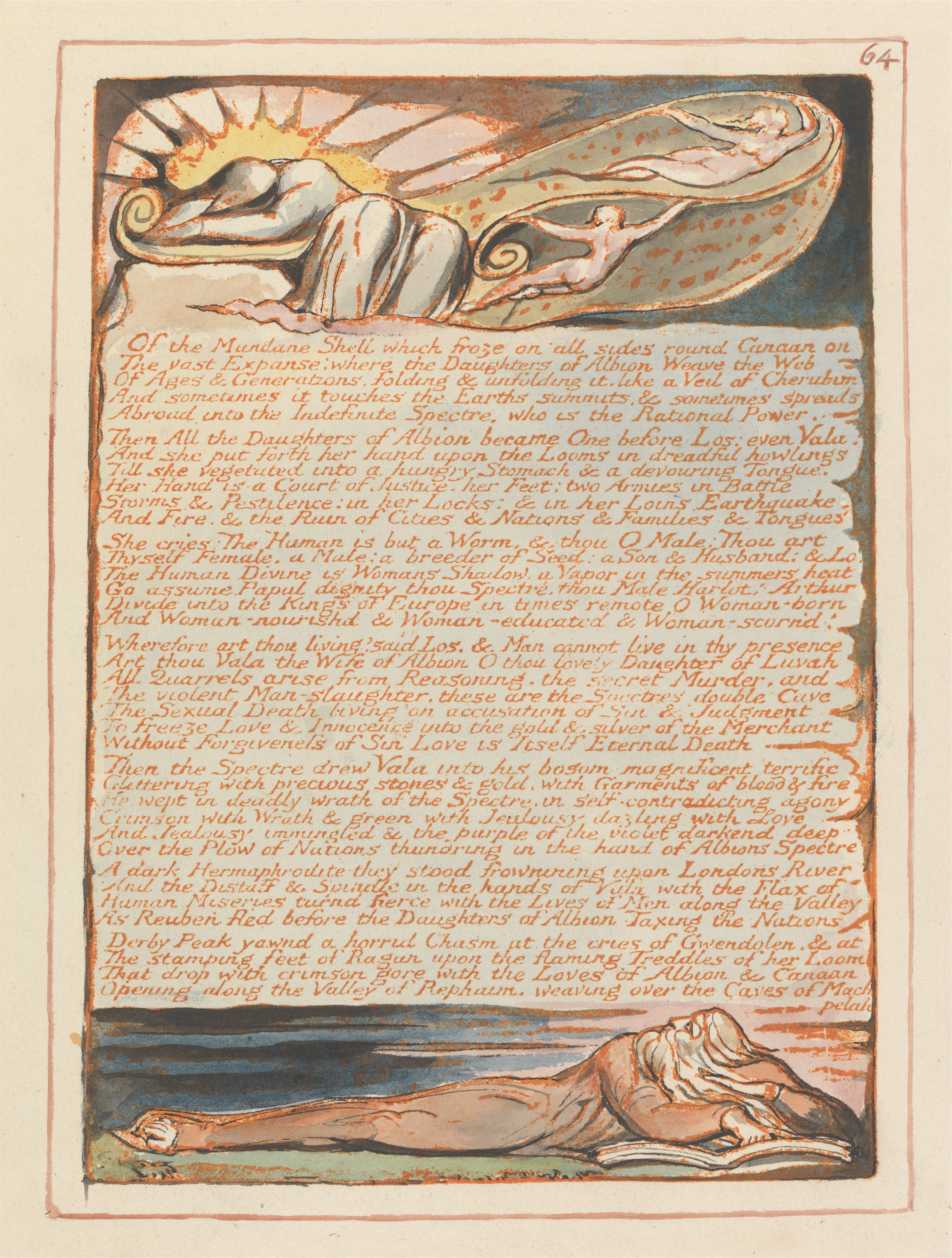 |
Jerusalem Plate 64 |
"The visual conception suggests the emanation of poetic thoughts from the mind of an inspirited dreamer whose rational self tries to inscribe the vision's literally unreadable marks." The Illuminated Books - Volume 1.
I've read that when Joseph Campbell began to write for popular consumption he had to learn a new style of writing. Previously his academic writing had followed a direct line of reasoning from a premise to a conclusion without digression or repetition. If he wanted the general public to read what he wrote and understand it that couldn't be his model. The general reader needs to be to told in the beginning the purpose, he needs to have the material explained or illustrated, and then he should be told what conclusions he might draw.
These biographical passages that you are giving to your readers
now follow neither of these two patterns. They are scattered
episodes drawn from your memories. If they have particular
significance to you or to the reader, it must be discerned within
the context of a life. Our lives come to us along a time line but
there is a dimensional factor involved also. The second dimension
is what else is going on simultaneously in our psyches, in the
world and in people around us at a specific point in time. The
third dimension is what went before and what will come after; this
is where meaning and purpose enter. These aspects can't be made
explicit because they are unfolding in a dimension outside of time
- in eternity.
"The Most difficult thing but an essential one – is to love Life, to love it even while one suffers, because Life is all, Life is God, and to love Life means to love God.”
(This post was requested by my good wife.)
1943
I was 16. I graduated in Jan of 43. I had
seen an airview of the Duke campus at 10
and resolved to go there for higher education.
My folks put me on the Southerner, the main
line train that ran from New Orleans to
Boston (and maybe points farther north).
I had a seat in a coach car. I was there
23 hours, then I emerged at Greensboro, and
took the milk train which took another four
hours to get to Durham.
What an impression it made. Wow. But it was
nothing like New Orleans.
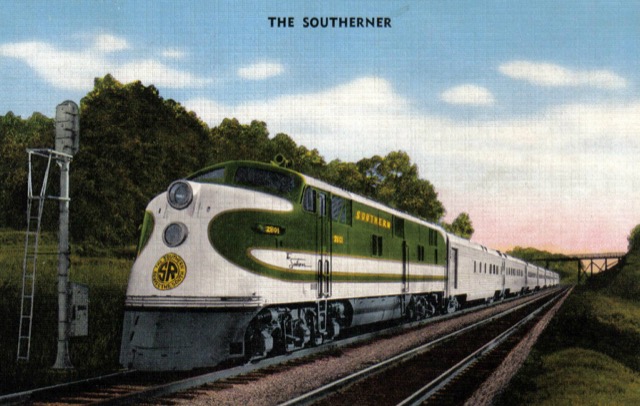
Since Larry was taking the Southerner he would have left from this station on Canal Street near Rampart. He lived at St. Mark's Methodist Church and Community Center located at 1130 N Rampart where his father had become pastor the previous year.
 |
New Orleans Terminal, Southern RR Canal Street and Basin. c 1908 |
"Bird's-eye View of New Orleans, Louisiana". Early 20th century postcard view. Text on back of card: "Bird's-Eye View Of New Orleans LA. This view is taken from the top of Hotel Grunewald showing that section of the City lying beyond the New Orleans Terminal Passenger Station". View shows a section of Canal Street at bottom left. Rampart street is to bottom of photo (someone has labeled it in green ink pen). The building with the large arch fronting Canal Street is the old Basin Street railway terminal. Krauss store visible on Canal just beyond it. Of particular interest is the row of buildings seen fronting Basin Street, including Tom Anderson's, Josie Arlington's, and Lulu White's, and "the District" behind it. This is one of the few published cards showing what history recalls as "Storyville"; from the card's language about "that section of the City" this was clearly an intended focus. The line of the old Carondelet Canal is slightly visible diagonally towards the top of the view. Note the view of the buildings at Canal and Rampart Street which were demolished for the construction of the new Saenger Theater in the 1920s."
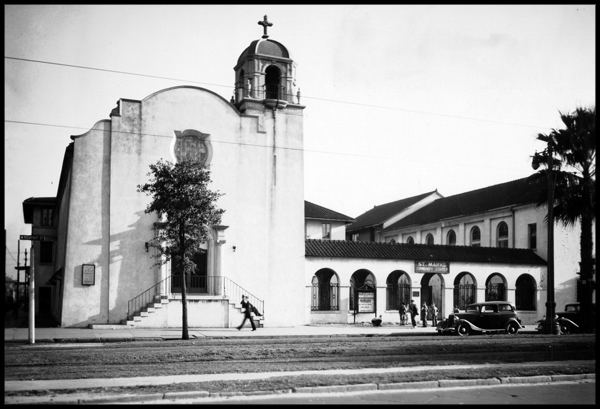 |
| St Mark's Methodist Church and Community Center |
"By
this time we were living at St. Mark's Community Center on North
Rampart St. on the edge of the French Quarter. It was still in the
Nichols School District. I rode the Rampart St. streetcar every morning
down St. Claude Ave. to school and back in the afternoon. We lived on
the third floor of the community center directly above the swimming
pool. There was also a gymnasium. On the other wing was the church,
which Daddy served. A fairly small church it still had representatives
of 21 nationalities. I suppose it was pretty close to unique in the
denomination. Dad got along pretty well there, stayed four years, the
first time he had ever had an appointment that long. He liked New
Orleans and had no desire to leave. In fact all the ministers liked New
Orleans. Those who got there stayed as long as they could."
"In 1942 I bought a used bicycle on time (50 cents/week) and went to work as a Western Union messenger (people communicated by telegram in those days). The job was roughly from 4 to midnight, although sometimes I worked longer.
It must have been after Christmas that I found employment
as a Western Union delivery boy. For the next few months I rode my bike
all over the city. I remember going as far as Westwego--a long, long
way from 314 Carondelet, the Western Union Office. I frequently rode
as much as 30 miles. The original idea was to work a few hours in the
afternoon, but like so many of those low level jobs, they were always
short of help, and I worked as long as I wanted to.
I rode all over Orleans Parish that year, and
parts of Jefferson and St. Bernard delivering telegrams in dozens of
"houses of ill fame"; those girls were anxious to hear from someone.
(It was said that every brothel in N.O. was on property owned by the
mayor; he was also reputed to be allied with the New York mafia. N.O.
was a rocky city in those days, as it has always been.)"
Dylan's version of House of the Rising Sun
There is a house down in New Orleans they call the rising sun
And it's been the ruin of many a poor girl and me, oh God, I'm one.
My mother was a tailor, she sowed these new blue jeans
My sweetheart was a gambler, Lord, down in New Orleans.
Now the only thing a gambler needs is a suitcase and a trunk
And the only time when he's satisfied is when he's on a drunk.
He fills his glasses up to the brim and he'll pass the cards around
And the only pleasure he gets out of life is rambling from town to town
Oh tell my baby sister not to do what I have done
But shun that house in New Orleans they call the rising sun.
Well with one foot on the platform and the other foot on the train
I'm going back to New Orleans to wear that ball and chain.
I'm going back to New Orleans, my race is almost run
I'm going back to end my life down in the rising sun.
There is a house in New Orleans they call the rising sun
And it's been the ruin of many a poor girl and me, oh God, I'm one.
________________________
Another sad tale connected to this account is the attempted integration of the New Orleans Public School system in 1960. In the vicinity of St Marks United Methodist Church were the two schools which had been selected to have a few black first graders enroll in white schools. The whites protested with demonstrations and refusal to send their children to the schools with the little black girls. When the minister at St Mark's Rev Lloyd Anderson Foreman saw the reaction he broke the boycott by walking his 5-year-old daughter Pam through an angry mob back to school.

He tasted the bitter draft of suffering and failure but he learned
to wait in patience until there germinated in his agile mind the
Great poetry of Paradise Lost and Paradise Regained.
I want you to know something about this picture.
It was taken at Riverwalk in New Orleans. It was on the day before your first birthday. Larry's sister, Aunt Margaret was making a rare visit to the East. It was something of a Clayton family reunion. On the left is Larry's cousin Dorothy, niece of Larry's father. Next is Larry's sister Margaret. Beside her is Larry's second cousin Marjorie (daughter of Dorothy) unless I am mistaken. The next four you know - Larry, Rennie, Kim and Mark. After that is Larry's cousin Mildred, sister of Dorothy.
Mildred lived in New Orleans and had a birthday party for you.
Dorothy lived in Shreveport. Margaret lived in San Bernadino, Ca.
Larry and I lived in Salem, SC. And of course you and your mom and
dad lived in College Station, Texas.
Dorothy, Margaret, Marjorie, Larry, Rennie, Kim, Mark, Mildred

Larry'sfamily3_v1.jpg
Although I attended a small indoor Quaker Meeting last Sunday, I choose today to respect the spread of the Omicron variant of the virus and stay away from people until the outbreak seems to be under control.
I knew I could find a lovely quiet place in Old Salem to enjoy the silence on this the first First Day of 2020. The campus of Salem Academy offered the perfect place.
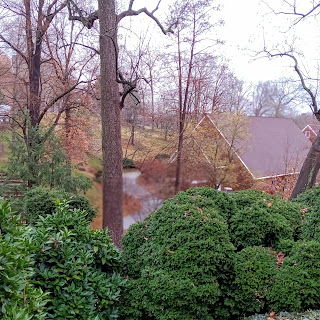
This is where I sat to meditate.


The walkways lead to an amphitheater.

I didn't go all the way down because I didn't want to climb back up.

The spring house marks the original water source for the town of Salem.

Beautiful old trees and shrubs are everywhere.

Adjacent to the campus of Salem Academy (begun in 1772) is the traditional Moravian burial ground - God's Acre.

