Showing posts with label shakespeare. Show all posts

Tuesday, November 24, 2015

Glasgow Thesis


"All the World's a Stage": William Blake and William Shakespeare

MacPhee, Chantelle L. (2002) "All the World's a Stage": William Blake and William Shakespeare. PhD thesis, University of Glasgow.
Full text available as:
[img]PDF 
Download (32MB) | Preview

    Abstract

    Shakespeare's presence in Blake's poetry has been virtually unrecognised by scholarly criticism except, of course, for Jonathan Bate's groundbreaking work of 1986. Bate has had no major successors, so this thesis is, then, an attempt to close to lacuna, to restore Shakespeare to the place that was recognized by Blake himself, as a major influence on his work. In my introductory chapter, I offer a brief sketch of the manner in which Shakespeare informed the culture of the later eighteenth century of which Blake was a product. I survey Shakespearean production, staging and acting techniques, and the history of textual reproduction, before turning to an aspect of the Shakespearean tradition of particular importance to Blake, the production of illustrated editions of Shakespeare's work, and the recourse to Shakespearean subject matter of the painters of the later eighteenth century. I end this chapter with an account of Blake's own Shakespearean illustrations. In Chapter 2, I focus on the earliest of Blake's poems to show a clear Shakespearean influence, the dramatic fragments: "Prologue to King John", Edward the Third, and "Prologue to Edward the Fourth". The major model for these early poetic experiments is, of course, the Shakespearean history or chronicle play, but I argue that even in these apprentice works Blake's appropriation of the Shakespearean model is complex. Shakespeare's history plays celebrate the emergence of an England that, as the defeat of the Spanish Armada demonstrated, had emerged as one of Europe's most powerful nation states. The most pressing political context for Blake's dramatic fragments is England's loss of America, its greatest overseas colony. The fragments are addressed, then, not to a confident nation, proud of its newfound position in the world, but to a nation that had very recently suffered a major blow to its confidence. Already evident, too in these early fragments is Blake's distrust of the Shakespearean notion, flamboyantly expressed in a play such as Henry V, that a nation's greatness might appropriately be measured by its military successes, particularly in war against another state.
    Item Type:Thesis (PhD)
    Qualification Level:Doctoral
    Subjects:P Language and Literature > PR English literature
    Colleges/Schools:College of Arts > School of Critical Studies > English Literature
    Supervisor's Name:Cronin, Prof. Richard and Prickett, Prof. Stephen
    Date of Award:2002
    Depositing User:Ms Aniko Szilagyi
    Unique ID:glathesis:2002-3467
    Copyright:Copyright of this thesis is held by the author.
    Date Deposited:21 Jun 2012
    Last Modified:10 Dec 2012 14:07
    URI:http://theses.gla.ac.uk/id/eprint/3467

    Actions (login required)

    View ItemView Item

    Downloads

    Downloads per month over past year
    Nov2014Dec2014Jan2015Feb2015Mar2015Apr2015May2015Jun2015Jul2015Aug2015Sep2015Oct2015Nov20150255075100
    Year
    Nov 201420
    Dec 201433
    Jan 201533
    Feb 201534
    Mar 201543
    Apr 201556
    May 201553
    Jun 201595
    Jul 201540
    Aug 201570
    Sep 201550
    Oct 201564
    Nov 201568
    The University of Glasgow is a registered Scottish charity: Registration Number SC004401                                                          

    Friday, November 20, 2015

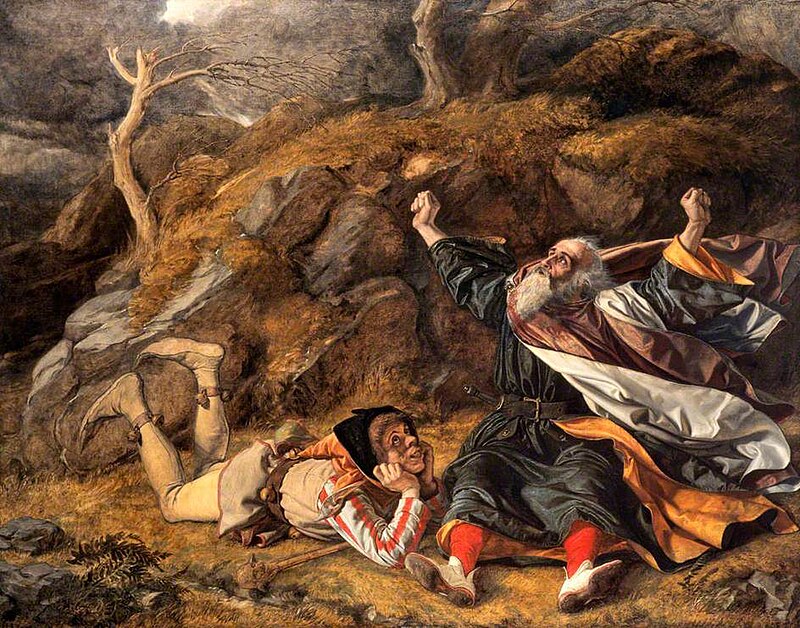
    King Lear

    Chapter Four of Steven Marx's book is about the play, King Lear; if we examine it we see the Book of Job as the primary source for Shakespeare's story.

    King Lear is a  naked old man, forsaken by his wife and associates,

    very much like a man named Job.  Both had a great deal; now they have nothing.

    Look at this:


    Here's a picture of King Lear.


    King Lear and fool waiting out the storm
    by William Dyce (1806–1864)
    In wikii


    The Plot of the story -1:
    King Lear is deciding to give up his power and divide his realm amongs
     his three daughters, Cordelia, Regan, and Goneril. Lear's plan is to give the largest piece of his kingdom to the child who professes to love him the most, certain that his favorite daughter, Cordelia, will win the challenge.
    Goneril and Regan, corrupt and deceitful, lie to their father with sappy and excessive declarations of affection. Cordelia, however, refuses to engage in Lear's game, and replies simply that she loves him as a daughter should. 

    Her lackluster retort, despite its sincerity, enrages Lear, and he disowns 
    Cordelia completely. When Lear's dear friend, the Earl of Kent, tries to speak on Cordelia's behalf, Lear banishes him from the kingdom.

    2
    Meanwhile, the King of France, present at court and overwhelmed by
    Cordelia's honesty and virtue, asks for her hand in marriage, despite her loss of a sizable dowry. Cordelia accepts the King of France's proposal, and reluctantly leaves Lear with her two cunning sisters. Kent, although banished by Lear, remains to try to protect the unwitting King from the evils of his two remaining children. He disguises himself and takes a job as Lear's servant. Now that Lear has turned over all his wealth and land to Regan and Goneril, their true natures surface at once. Lear and his few companions, including some knights, a fool, and the disguised Kent, go to live with Goneril, but she reveals that she plans to treat him like the 
    old man he is while he is under her roof. So Lear decides to stay instead with his other daughter, and he sends Kent ahead to deliver a letter to Regan, preparing her for his arrival. However, when Lear arrives at 
    Regan's castle, he is horrified to see that Kent has been placed in stocks. Kent is soon set free, but before Lear can uncover who placed his servant in the stocks, Goneril arrives, and Lear realizes that Regan is conspiring with her sister against him. 

    In Lear he had 3 faithless daughters while Job's progeny just died.


    King Lear: General Introduction

    The epic tragedy, King Lear, has often been regarded as Shakespeare's greatest masterpiece, if not the crowning achievement of any dramatist in Western literature. This introduction to King Lear will provide students with a general overview of the play and its primary characters, in addition to selected essay topics. Studying a Shakespearean play deepens students' appreciation for all literature and facilitates both their understanding of themes and symbolism in literary works and their recognition of effective characterization and stylistic devices. 


    Thursday, November 19, 2015

    The Tempest

    The first play that Steven Marx dealt with was The Tempest.  The 'Tempest' has a tremendous amount of biblical source.
    In particular 'The Tempest' is related to 'Genesis', especially the 'Beginning':
    "1n the beginning God created the heavens and the earth. 
    Now the earth was formless and empty, darkness was over the surface of the deep, and the Spirit of God was hovering over the waters.


    And God said, “Let there be light,” and there was light. 
    God saw that the light was good,and he separated the light from the darkness. 
    God called the light “day,” and the darkness he called “night.” And there was evening, and there was morning—the first day."

    In 'The Tempest' Prospero (which relates to Prosperity):

    From wiki:


    In it, Prospero states his loss (magic) and his continuing imprisonment if the audience is not pleased. Many feel that since The Tempest was the last play that Shakespeare wrote alone, Prospero's feelings echo Shakespeare's own, or perhaps may even have been his "retirement speech"

    Also from Wiki:


    The Tempest is a play by William Shakespeare, believed to have been written in 1610–11, and thought by many critics to be the last play that Shakespeare wrote alone. It is set on a remote island, where the sorcererProspero, rightful Duke of Milan, plots to restore his daughter Miranda to her rightful place using illusion and skilful manipulation. He conjures up a storm, the eponymous tempest, to lure his usurping brother Antonio and the complicit King Alonso of Naples to the island. There, his machinations bring about the revelation of Antonio's lowly nature, the redemption of the King, and the marriage of Miranda to Alonso's son, Ferdinand.


    Thursday, November 12, 2015

    Shakespeare 1

    In Blake’s letter to Flaxman he wrote:
    “Now my lot in the Heavens is this; Milton lovd me in childhood &
       shewd me his face
    Ezra came with Isaiah the Prophet, but Shakespeare in riper years
        gave me his hand
    Paracelsus & Behmen appeard to me. terrors appeard in the Heavens
        above
    (Erdman 707)

    Which seems to mean that Shakespeare meant a great deal to Blake
    as a source for his ideas, poetry and pictures
    Here are some of the areas in Shakespeare that he used.
    In particular Blake produced many pictures and images involving
    Shakespeare’s works:

    The abstract of  doctoral thesis at the University of Glasgow is very worth reviewing.

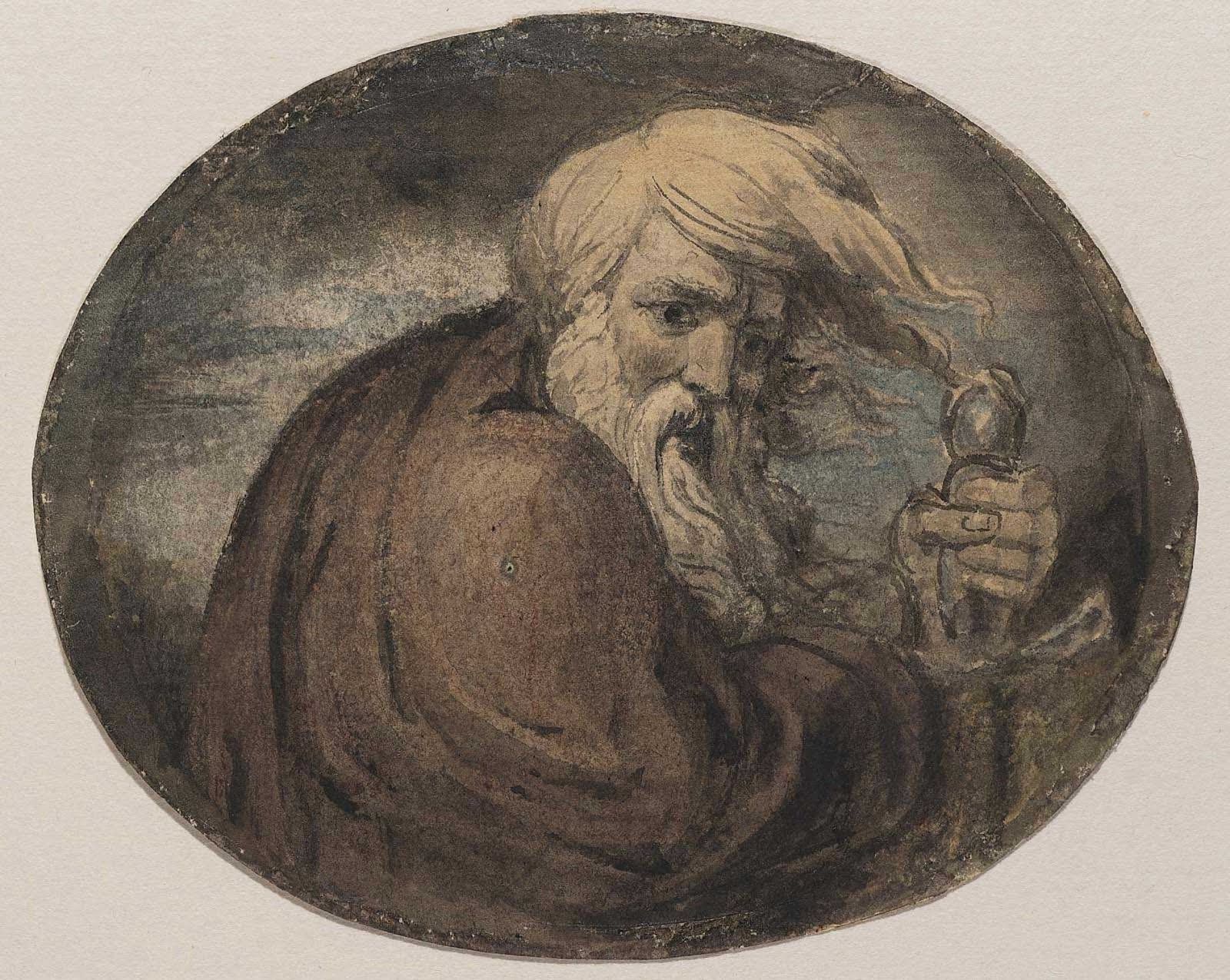
    Look for example to this picture of King Lear


    In a letter to Hayley dated 1804 Blake wrote about some pictures that he hoped to
    have printed including “ Lear & Cordelia. belonging to Mr Walker”
    and “,
    ………………………..an incomparable production, which
    Mr. W. bought for five shillings at a broker's shop; it is about
    five feet by four, and exquisite for expression; indeed, it is
    most pathetic; the heads of Lear and Cordelia can never be
    surpassed”

    Tuesday, October 27, 2015

    Shakespeare 0

     Shakespeare.

    October 30


    Shakespeare 0


    File:William Blake - William Shakespeare - Manchester City Gallery - Tempera on canvas c 1800.jpg

    From Wikimedia Commons, the free media repository

    English: Shakespeare by William Blake 1800
    Object Name: painting
    Artist/Maker: Blake, William Role in production: artist Place of Creation: Europe, United Kingdom, England Date: 1800-1803 (circa)
    Medium / Material: tempera
    Support: canvas
    Technique: tempera on canvas
    Description: A head portrait of William Shakespeare. He is depicted here with a faint smile, wearing an Elizabethan collar, surrounded by his own characters. To the right of the figurehead, Macbeth stands beside the three witches and to his left, Hamlet observes a ghostly crowned figure. A wreath of rose leaves frames his head whilst ferns fringe and decorate the top corners, in white on the right and black on the left.