Showing posts with label 2nd decade. Show all posts

Saturday, January 15, 2022

CHILD'S JOURNEY

Originally posted to In Old New Orleans on Saturday, August 29, 2009

 child's journey

(This post was requested by my good wife.)

1943

I was 16. I graduated in Jan of 43. I had
seen an airview of the Duke campus at 10
and resolved to go there for higher education.

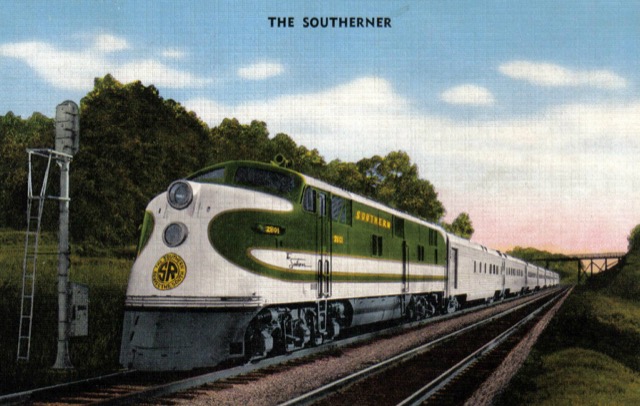
My folks put me on the Southerner, the main
line train that ran from New Orleans to
Boston (and maybe points farther north).

I had a seat in a coach car. I was there
23 hours, then I emerged at Greensboro, and
took the milk train which took another four
hours to get to Durham.

What an impression it made. Wow. But it was
nothing like New Orleans. 


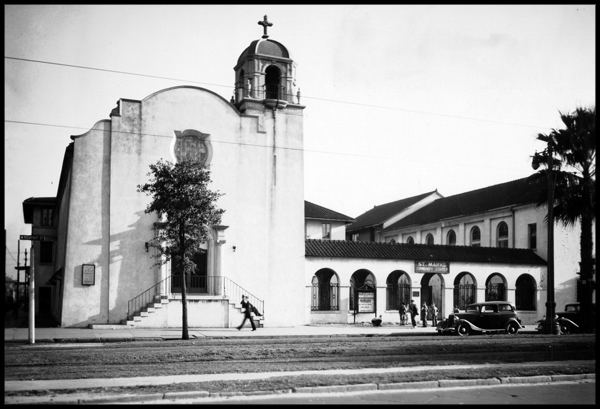
Since Larry was taking the Southerner he would have left from this station on Canal Street near Rampart. He lived at St. Mark's Methodist Church and Community Center located at 1130 N Rampart where his father had become pastor the previous year.


New Orleans Terminal, 
Southern RR
Canal Street and Basin. c 1908

"Bird's-eye View of New Orleans, Louisiana". Early 20th century postcard view. Text on back of card: "Bird's-Eye View Of New Orleans LA. This view is taken from the top of Hotel Grunewald showing that section of the City lying beyond the New Orleans Terminal Passenger Station". View shows a section of Canal Street at bottom left. Rampart street is to bottom of photo (someone has labeled it in green ink pen). The building with the large arch fronting Canal Street is the old Basin Street railway terminal. Krauss store visible on Canal just beyond it. Of particular interest is the row of buildings seen fronting Basin Street, including Tom Anderson's, Josie Arlington's, and Lulu White's, and "the District" behind it. This is one of the few published cards showing what history recalls as "Storyville"; from the card's language about "that section of the City" this was clearly an intended focus. The line of the old Carondelet Canal is slightly visible diagonally towards the top of the view. Note the view of the buildings at Canal and Rampart Street which were demolished for the construction of the new Saenger Theater in the 1920s."

St Mark's Methodist Church and Community Center
 
St Mark's Church history
"In 1909, the work of the Mary Werlein Mission moved to Esplanade Ave. and was called St. Marks Hall. Out of this project, a "Church of Nations" emerged and was called St. Marks Methodist Church. The property on N. Rampart was purchased in 1916 and the buildings dedicated in 1924. The church and community center, though separate, shared the facilities. The church was supported for many years by the Board of Missions. Under Rev. Robert Jamieson, he church became self-supporting in 1946. Rev. Jamieson's 'parsonage' was a 5 room apartment on the 3rd floor of the community center."
 
(The Rev Robert Jamieson was my cousin. My Grandmother Louisa Ellen Lilly was the daughter of Robert Hafkesbring and Ellen Jamieson.)

"By this time we were living at St. Mark's Community Center on North Rampart St. on the edge of the French Quarter. It was still in the Nichols School District. I rode the Rampart St. streetcar every morning down St. Claude Ave. to school and back in the afternoon. We lived on the third floor of the community center directly above the swimming pool. There was also a gymnasium. On the other wing was the church, which Daddy served. A fairly small church it still had representatives of 21 nationalities. I suppose it was pretty close to unique in the denomination. Dad got along pretty well there, stayed four years, the first time he had ever had an appointment that long. He liked New Orleans and had no desire to leave. In fact all the ministers liked New Orleans. Those who got there stayed as long as they could." 

"In 1942 I bought a used bicycle on time (50 cents/week) and went to work as a Western Union messenger (people communicated by telegram in those days). The job was roughly from 4 to midnight, although sometimes I worked longer.

It must have been after Christmas that I found employment as a Western Union delivery boy. For the next few months I rode my bike all over the city. I remember going as far as Westwego--a long, long way from 314 Carondelet, the Western Union Office. I frequently rode as much as 30 miles. The original idea was to work a few hours in the afternoon, but like so many of those low level jobs, they were always short of help, and I worked as long as I wanted to.

I rode all over Orleans Parish that year, and parts of Jefferson and St. Bernard delivering telegrams in dozens of "houses of ill fame"; those girls were anxious to hear from someone. (It was said that every brothel in N.O. was on property owned by the mayor; he was also reputed to be allied with the New York mafia. N.O. was a rocky city in those days, as it has always been.)"

"Graduation day at Nichols came for me in January of 1943--I was 16. We had to dress up in tuxedos, which I found awkward and uncomfortable. I suppose most of the class went on to dances and celebrations of various sorts, but that was not in my world.

The big thing in my world was to get on the Southerner a few days later and make the 23 hour ride to Durham where I enrolled at Duke. This represented a desire to get away from home, especially to get away from my father, toward whom I had harbored very negative feelings for a number of years. I got away, and I never came back (to live), although I certainly did visit from time to time."

Dylan's version of House of the Rising Sun

There is a house down in New Orleans they call the rising sun
And it's been the ruin of many a poor girl and me, oh God, I'm one.

My mother was a tailor, she sowed these new blue jeans
My sweetheart was a gambler, Lord, down in New Orleans.

Now the only thing a gambler needs is a suitcase and a trunk
And the only time when he's satisfied is when he's on a drunk.

He fills his glasses up to the brim and he'll pass the cards around
And the only pleasure he gets out of life is rambling from town to town

Oh tell my baby sister not to do what I have done
But shun that house in New Orleans they call the rising sun.

Well with one foot on the platform and the other foot on the train
I'm going back to New Orleans to wear that ball and chain.

I'm going back to New Orleans, my race is almost run
I'm going back to end my life down in the rising sun.

There is a house in New Orleans they call the rising sun
And it's been the ruin of many a poor girl and me, oh God, I'm one. 

________________________

Another sad tale connected to this account is the attempted integration of the New Orleans Public School system in 1960. In the vicinity of St Marks United Methodist Church were the two schools which had been selected to have a few black first graders enroll in white schools. The whites protested with demonstrations and refusal to send their children to the schools with the little black girls. When the minister at St Mark's Rev Lloyd Anderson Foreman saw the reaction he broke the boycott by walking his 5-year-old daughter Pam through an angry mob back to school.

Saturday, May 15, 2021

HIGH SCHOOL YEARS

Second Day

It must have been 1940 when Daddy got his first appointment in town. Our first hot water and the first alternation between town and country that has characterized my life and made me what I am today. It was another 'between conference' appointment. Dad had been reappointed to Kentwood for the third year--the first time that had happened. Then an opening came up in New Orleans,and Dad jumped at it.

Dad had lived as a child and married in the uptown ("silk stocking") part of New Orleans, but this appointment (to a church called Chalmette) was down on North Galvez St., a few blocks from the Industrial Canal. An industrial area with working class people, it later went completely black. But it was New Orleans, and we were all glad to come in out of the country.

Margaret was at Southeastern College in Hammond by this time. She didn't take kindly to college, and in fact she soon went out to California, perhaps to spend the summer with our grandparents, but she never came back.

She got a job with the Santa Fe Railroad, met and married Jimmy Thomas, a fellow employee and became a southern Californian, as had Grandfather, Grandmother, Auntie, and her family.

I entered Francis T. Nichols High School at the age of 14. It was thought that I would go to Warren Easton, a much older school. The schools all seemed to be going down hill, but Nichols was brand new and the first public coeducational high school in the city. Morale there was good, the faculty was (relatively) good, and it was generally thought to be the best public school in the city. No doubt people related to the other schools had different ideas about that.

I was completely out of the majority peer group community--a callow, undersized, rural boy. Football became much less of an interest. I had a
small group of acquaintances with whom I ate and passed our limited leisure time. I did well academically, got the bookkeeping award, and in
fact ended up ranked second in a class of 150 odd.

The only academic problem I had was Industrial Arts. Everyone had to take Industrial Arts as a general rule. I found myself in a metal working
shop, got an assignment to make a small gauge--actually a piece of metal a couple of inches square with small variations. I did mine, and then took it to the instructor, and he said "good. You get 75." I wasn't used to getting 75.

I talked to Dad about it and he came down to school one day, and they allowed me to transfer to Spanish. That was the end of my mechanical
career.

I enjoyed Spanish. We had Miss Serrano, a real Spanish woman, and we all got along well. Spanish became one of my major interests. I did two years of it in high school and another two years with Professor Castellano at Duke, but didn't achieve any speaking capability. Later visiting South and Central America I did learn to use it a bit in general conversation. In fact at one time I was more articulate in Spanish than in English, not so
much due to a command of the language, but rather because I experienced a different, freer persona in Spanish. Spanish is a very eloquent language. I once waded through Don Quixote and understood
that 50,000 different words appear in it. That meant an awful lot of consultation with the Spanish-English dictionary. On the other hand in
Columbia we were told that the longshoremen had a vocabulary of 60 words.

Edgar Quillen, son of a prominent member of Dad's church was a year younger than I, but in my grade at school. He and I became close. 50 years later Edgar was the only person outside my family that I had known since high school days. Mother and especially Dad often depreciated Edgar (I don't remember just what deficienies they found in him), but he was virtually my only friend, and a good one through the years. I thought they were pretty insensitive not to realize his importance to me. I suppose most or all parents seem insensitive to their children at one time or another.

The day we first arrived in New Orleans I had put on my skates and rolled uptown to Canal Street, some 38 blocks. That was a really exciting place.
I came out in the city center, looked around a bit, and rolled back to 3839 N Galvez St. I needed wheels, but a bicycle had always been out of the question economically. At that time I was getting an allowance of 30 cents per week. Dad gave me a job cleaning up the church which brought
me another 50 cents, and with these financial prospects I contracted to buy a second hand bike at 15 dollars on time. Prior to that I had saved
my money for a couple of years and bought a $3 Spaulding tennis racket, but I had little opportunity to play tennis in New Orleans.

The first summer in New Orleans I started bicycling out to Lake Pontchartrain, a distance of three miles. I gained some proficiency as a swimmer. I also wound up with a strep throat late in the summer. It was just before the advent of antibiotics. Dr. Crichlow came to the house and gave me some sort of medicine and a prescription to drink 6 7-Ups each day. I was a pretty sick boy, but obviously recovered. Dr. Crichlow had brought me into the world, and some time later his son, Bob Crichlow, presided at Daddy's funeral, and maybe mother's as well. He had also been pastor at Bogalusa when we were at Angie/Varnado. The two families thus had a strangely parallel career although we were never close.

Dad was not able to please the working class folks at Chalmette, and Conference found him reassigned to Golden Meadows, down on Bayou Lafourche, almost to Grande Isle. He refused to move us down there;
instead we got a house a couple of blocks from the parsonage, and he went down on weekends. I remained in school at Nichols.

A few times I went down to Golden Meadow with Dad. One weekend in December I remember especially. We were coming back to New Orleans after the morning service, listening to the New York Philharmonic on
the radio when the announcer broke in to tell of the attack on Pearl Harbor. The war became a matter of great engrossment to everyone.

In spite of the war or maybe because of the war I found the 10th grade quite a drag. The intellectual level seemed minimal, no challenge, and no social fulfillment to speak of. It must have been after Christmas that I went down and found employment as a Western Union delivery boy. For the next few months I rode my bike all over the city. I remember going as far as Westwego--a long, long way from 314 Carondelet, the Western
Union Office. I frequently rode as much as 30 miles. The original idea was to work a few hours in the afternoon, but like so many of those low level jobs, they were always short of help, and I worked as long as I wanted to.

I remember visiting quite a number of brothels--most of them were in the area between St. Charles and Claiborne just above Canal Street. We all knew of course that Mayor Bob Maestrie owned all the brothels in New Orleans. I never had any business with the girls other than to deliver their telegrams. On another occasion I found myself singing in the Blue Room, a fancy lounge in the Roosevelt Hotel. It was a singing telegram to a soldier; I remember that he gave me no tip, although I frequently received tips for my services.

I received 30 cents per hour for the work and used and maintained my own bicycle. When I worked 40 hours, it came to $12. I frequently worked over 40 hours. Over 40 it went to 45 cents per hour. A few times I worked well into the morning and slept in rather than going to school. It was okay
because school was so undemanding. That was a long spring, but it finally ended.

By the end of school that spring I was ready for something better. I answered an ad for a magazine selling crew. Started out across country. We were supposed to tell the customers we were trying to win a contest in which the prize was flight training so we could be fighter pilots. Something
just about that ridiculous. I simply couldn't do it. One credulous lady believed my story and I felt guilty as hell. We went down to Grand Isle.
The rest of them went to a honky tonk, but I walked back to the motel. The thing came to a head in Houston. One of the others suggested we
get a job in the ship yard. I wrote home or phoned for money, but instead Dad came over and got me. The whole thing was a complete disaster.

Reflecting on it I see that it represented my desire to get away from the stifling environment at home. I was just turned 16. Well I managed to
get a job as a bookkeeper at Black, Rogers Insurance Co. I spent all day writing line by line entries in a journal of insurance transactions. $75 per month. I wore a coat and tie and went up to the 4th floor (or some such) in
one of the main office buildings in New Orleans. I had in a measure gotten away from home. September came, and I intended to keep my job. Dad wasn't worried about that. He probably figured I could get a high school diploma any time I wanted to. But at the last minute I got cold feet. I told my boss I was going back to school. He was disturbed at being left in the lurch, but I agreed to stay on another week or so to allow him time to get a replacement.

I went back to school, hating it. Mother knew how I felt, and she did something really generous. She bought me a violin, and that of course became my major interest. Karl Kilinski gave me a lesson every week, and I made good and quick progress. It was that violin that made it possible for me to get through that last semester of high school (I had enought credits to finish in January).

By this time we were living at St. Mark's Community Center on North Rampart St. on the edge of the French Quarter. It was still in the Nichols School District. I rode the Rampart St. streetcar every morning down St. Claude Ave. to school and back in the afternoon. We lived on the third floor of the community center directly above the swimming pool. There was also a gymnasium. On the other wing was the church, which Daddy served. A fairly small church it still had representatives of 21 nationalities. I
suppose it was pretty close to unique in the denomination. Dad got along pretty well there, stayed four years, the first time he had ever had an appointment that long. He liked New Orleans and had no desire to leave. In fact all the ministers liked New Orleans. Those who got there stayed as long as they could. Rev. Melbert at First Church stayed 18 years.

Graduation day at Nichols came for me in January of 1943--I was 16. We had to dress up in tuxedos, which I found awkward and uncomfortable. I suppose most of the class went on to dances and celebrations of various sorts, but that was not in my world.

The big thing in my world was to get on the Southerner a few days later and make the 23 hour ride to Durham where I enrolled at Duke. This represented a desire to get away from home, especially to get away from my father, toward whom I had harbored very negative feelings for a number of years. I got away, and I never came back (to live), although I certainly did visit from time to time.

.

Friday, May 14, 2021

GOING TO SEA

SECOND DECADE

Built as Wood Lake in 1944

 Some time in March I got word to report to the Wood Lake, a new T2 tanker being commissioned at the shipyard in Mobile. I went over and went aboard in time for the shakedown trip, which lasted a few days and happened largely in the gulf in the immediate environs of Mobile. I was just a passenger on that trip because a special crew used the radio equipment. Later two other radio operators came aboard. Since I was so young and inexperienced the Captain decided I should be the 3rd officer; it still seemed pretty impressive to me. I had a commission and uniform as an ensign in the Maritime service, very similar to that of a naval ensign.

LARRY CLAYTON - RADIO OFFICER

Capt. Barton chose as the chief radio officer Drummond, a man in his 30's who seemed much older. Drummond was slightly limited intellectually and especially in terms of vision.  He would not go out at night because he had no peripheral vision and was afraid of getting disoriented.  The second officer, Fitzpatrick, was 26, married, and considerably more agile than Drummond.


We made three trips on the Wood Lake over a period of about 4 months.  The first time we went to Liverpool.  We carried 100,000 gallons of aviation gasolene and 12 Lightnings on deck.  (Jimmy Thomas, my brother in law, flew that plane in the Pacific.)

We stayed only 2 or 3 nights in Liverpool. Tanks never stayed long.  In fact I came close to missing the ship because I had taken a train down to London to see the place, thinking (correctly) that it might be my only opportunity.  I stayed in London one night and considered staying another, but decided to go on back to Liverpool.  It happened that I made just about the last liberty launch back to the ship before she sailed.  I've often reflected that my life would have been vastly different had I missed that ship.  (About missing ships, more shortly.)

We traveled back and forth across the Atlantic in large convoys--of 50 or 100 ships at about 14 knots.  Slower convoys made up of Liberty Ships and other slower craft traveled in other convoys.

We left Liverpool just in time to escape a German air raid.  This was the first of two occasions when I was near combat, but never in combat. I suppose we were near combat a few times during the voyages without necessarily knowing it.

The Merchant Marine suffered higher casualities during the war than any of the military services, one reason that draft deferment was virtually automatic. The German submarines had inflicted heavy losses on Allied shipping in the Atlantic in the previous year, but by the time I got out there the submarine menace had been brought pretty well under control.  Actually a tanker had been sunk 30 miles out of Mobile shortly before I started, and some of her crew had been reassigned to our ship.

On our trips back and forth across the Atlantic we often got submarine alarms or rather possible submarine alarms.  Sonar signals had suggested the possibility, perhaps set off by whales or whatnot, perhaps by by submarines.  The British corvettes and American destroyer escorts constantly scurried around the convoy checking out these alarms.  We had large insulated wet suits to use in case of being sunk.  Drummon slept in one of these as I recall.  But generally we became quite accustomed to the alarms and paid little attention to them.

Still when I got home, I was napping on the living room sofa when someone rang the doorbell, and I jumped about two feet.  Strange.  I had grown accustomed to the alarms, so they didn't bother me.  But apparently at home I had let down my guard and released the genie out of the bottle, the residue of fear of which I was unconscious.

Allied merchant ships preserved radio silence throughout the war, so I never sent a signal until after VE day.  Our work consisted of spending four hours sitting beside the radio and monitoring incoming traffic, then 8 hours off, then 4 on and 8 off as long as the ship remained at sea.  The radio watch was secured in port, making us especially privileged characters since we had nothing to do unless we were at sea.  Another facet of the privilege about the position was that no one knew anything about our job.  We had no supervision to speak of and lived more or less in a world of our own.  The only person we reported to was the Captain, and he rarely had time to pay any attention to us.  During these watches I took up smoking to while away the time.  I remember that I would allow myself one cigarette an hour and it would last about ten minutes.  Three cigarettes would get me through a watch.  I didn't stop smoking until some 13 years later.

After some days on the east coast we made a trip over to Casablanca.  It had been liberated a short time before this.  We heard terrible stories of westerners who went down into the medina or Arab quarter and suffered horrible mutilations.  We stayed in the French part of town.  We didn't stay long, but soon returned to New York.  A baby flattop was sunk in that area shortly after we left.

Our third trip took us to Bristol.  Once again we stayed only a night or two.  Fitzpatrick, the second radio officer, was something of a lady's man.  we had just cast off our lines and were heading for the sea when he came running up to the dock.  We waved at him, but he had missed the ship.  Later we learned that he had managed to getaboard another tanker belonging to our company.

Of course his pay stopped the minute he missed the ship.  He worked in the galley of the other ship. The convoy got almost to New York when the other ship got orders to proceed to North Africa.  I met him in New Orleans some years later.  It had taken him over a year to get back to the states.  It seemed to me that his whole personality had changed, perhaps as a result of that sobering experience. He was learning to be a printer, and now seemed a very serious sort.

We were paid well in the war zone.  Base salary was about $150 a month for me, but there was a hundred percent bonus plus $5 per day in the war zone, all of which came to about $450 per month. In those days that was a princely sum, or so it seemed to me at the time.  With no living expensesI saved a considerable sum of money--about $5000 over the course of the years I went to sea.

We were in Bristol about two weeks before D-day, but on D-day we were in Houston.  I remember being on the main street there on the fateful day and turning into a big church.  Everyone went to church that day, no special services, just go in, sit down and lift up the troops.

We went from Houston back to New York.  It was time to sign on for the next overseas trip. I had been on the Wood Lake for about four months.  We signed on a voyage at a time.  I started to sign over, as we said, but decided I would go home for a visit.  A lucky decision since the ship went from New York to the South Pacific and was out there for the next two years.

Going home from New York on the train I met a young woman who lived in Pensacola.  Up to that time I had had very little experience with the opposite sex, but I suppose in my uniform I was a handsome devil.  We were taken with each other and agreed to write.  After a couple of letters in fact I went to Pensacola to see her, but nothing came of it.

I was a member of the Radio Officers' Union of the AF of L.  When I got ready to ship out again, I went down to the union officer and met the union rep.  An old sailor, but a man of some culture, I don't remember his name. He got me a berth on the Pan York.  This was an old tub built about 1900. We had given it to the Panamians, but due to the war we took it back.  It ran between New Orleans and ports in Panama and Columbia.  It's speed was about the same as the tankers; it had once been a pretty good ship.

We almost always went first to Panama (the Atlantic side).  There were two towns on the coast there: Christobal, where we usually docked and where the U.S.military reservation was located. We sometimes visited the army installations and enjoyed their good and cheap ice cream.  The other town was Colon, the native place.  About all we knew of it was the bars and brothels.

In Panama I took up drinking.  I was still 18, and I found that in port I was on the ship by myself; everyone else was over in Colon drinking.  So I went over and joined them.  The most common drink was rum and coke (20 cents).  I consumed many a rum and coke over the next six months; I did most of my drinking when we were in Panama.  I remember a couple of drinking friends.  One was a seaman who had absolutely nothing to say aboard ship. But when he went ashore he usually lasted a couple of hours, and his shipmates would bring him back all banged up (from a fight) and just about out of his mind.  This man was a great checker player.  I had him up in the radio shack a time or two for a game.  As I say, he never had anything to say, but he knew how to talk with checkers.

Another hard drinker was the purser.  He was a fairly high class man, but he was bad to drink. One day in the saloon (that's what we called the officers' dining room) in a half sober state he turned to me and said "Sparks, ou're a nice kid, but you sure are getting to be a terrible wino." Me, I thought, my Lord; I don't drink half as much as you do.  But he made me do some thinking about it as a consequence of which I got off the Pan York at the end of that trip.

That trip had an eventful end.  We passed through a hurricane in the gulf.  The double bottom was flooded; a gigantic wave took off the lifeboat just outside of the radio shack.  The Captain decided we had better break radio silence and contact the Coast Guard.  So the Armed Guard Officer, who had custody of the code books, encoded a message telling them our position, course, speed, and predicament.  I had been up all day of course, and I didn't intend to keep working without lawful compensation.  So I asked the Captain if he wanted me to work overtime.  He said no, so I went to bed.

I actually slept longer than I should have and missed the 3 A.M. BAMS (Broadcasts to Allied Merchant Ships).  At 6 I got a coded message asking for further particulars, but by that time we were in the river.  At New Orleans some Coast Guard brass came aboard for an inquiry.  In the course of the inquiry they called me in and wanted to know where I had been between midnight and 8 A.M. “In my sack" I said.  No response.  Lucky I was not some kind of poor devil of an armed forces personnel.


After a brief vacation from the Pan York I was assigned to another brand new ship; this was the Sea Dolphin, a C III that had just been built in Pascagoula. These were superior types of cargo ships; they went about the same speed as the tankers.


I'm not sure which trip it was that I visited Rouen and LeHavre.  Seems like it must have been the first trip of the Sea Dolphin.  I was the chief operator on this ship, and I have very little recollection of the boys who worked with me.  Going across the Atlantic in a large convoy we were apparently rerouted with a radio message to the south of France, but for some reason we didn't get the message and showed up in Rouen.  I don't suppose it made a great difference since hundreds of ships were going to all those ports at that time.

I had gone to London from Liverpool, and now I figured I had better see Paris while I was in France, so I took a train up the Seine.  It was beautiful, but I was completely out of it there. No one spoke English, and no one seemed in the least interested in being of help.  That is, until I found a USO.  I walked in and met a GI on leave. He showed me Paris, but I don't remember much of what transpired.  The next day I went back to Rouen.

On our next trip we went from New York to Calcutta, through the straits of Gibraltar (without stopping), Port Said, the Suez Canal and the Red Sea.  We stopped at Aden, a British Crown Colony for routing instructions (It now goes by the name of Yemen.)  The Captain, the armed guard officer, and I went ashore about 8 A.M.  It took about half an hour to finish our business.  The Captain asked the Limeys where we could get a beer.  They said no alcohol was served there before noon.  The skipper said, "Humph, I wouldn't stay here until noon for Cleopatra herself."  It was about 125 in the shade, but soon we were in the Arabian Sea with cool breezes.

We got to Calcutta 28 days out of New York.  We had set a record for a freight vessel.  I remember the excitement of going up the river to Calcutta. From the deck you could see villages scattered around in all directions with cultivated fields between them.  Teeming with people, tremendously exotic.

At Calcutta we saw people whose only home was the street, people dying of cholera, etc.  A rich man had opened his home to the Allies; it was like a museum, certainly not the kind of place you would want to live, but with European masterworks of art on the walls, big overstuffed sofas, everything associated with western affluence.  We heard that he fed 150 beggars every day.  We visited a temple with carvings of sexual intercourse in 50 different positions.  We visited the burning ghats (?) where the dead were brought.  We saw one corpse being burned; the heat caused the tendons to contract and the poor body started to rise up. The attendant grabbed a stick and beat it back down. The sacred river was right there with all sorts of dead things in it and people bathing.

Dozens of children followed us around begging.  I bought a leather suitcase from a merchant on the sidewalk. He asked $100 for it, but sold it for $10. I could probably have gotten it for less, but I had gotten tired of dickering with him.


Calcutta made a powerful impression on me.  I felt the powerful need of help that so many had there. I felt that I had a choice, to dedicate the rest of my life to trying to help them, or to harden my heart.  It's obvious which choice I took, since I left a few days later and never went back.

We went back around the Cape of Good Hope, stopping at several ports of call in East and South Africa.  During that trip and the next one we visited Zanzibar, Mombasa, Beira, Port London, Elizabeth-town, Capetown. and perhaps some others I have forgotten.

I was deeply impressed with the animal grace of some of the blacks; they moved like gazelles.  And they were so black. (We don't have many blacks in our country.  We have a mixed race which contains some black blood. Black in America is really an ethnic rather than a racial term, although few people realize that.)

I rented a sailboat in the bay at Beira. Mozambique was a province of Portugal.  Of course it became independent like all the rest of the European colonies.  Kenya and Tanyanika each became something else, and some of those graceful blacks became bloodthirsty maus-maus.  Zanzibar was a bazaar, a meeting place of Asia and Africa; we westerners a microscopic minority.  The ports in South Africa were middle class, clean, more like ours than anywhere else I visited in my travels.  Gen Jan Smuts was in charge, a liberal. Apartheid settled upon the country suddenly and drastically a few years later.

The South African girls were very receptive.  I remember one party with about 4 couples that lasted most of the night.  Everyone had a lot of brandy.  We all expected to go home with the girls, but by the time that time came we were too inebriated to pursue them any further.  Such is life. I was young and innocent and my time..not yet.

On that or the next trip, which also involved east and south Africa, VJ day occured--the end of the war.  A wild celebration that I had little to do with.  As usual I lived in my own little kingdom--the chief radio operator now, with a nice two room apartment on the boat deck, far from any other quarters.

It must have been the next trip that the fog incident occured.  With the war over convoys no longer sailed, it was very ship for itself.  And the Atlantic was about as clogged with shipping as it has ever been, before or since.  A mad rush to bring home the GI's and all their paraphernalia. Hordes of ships in the main shipping lane between the United States and the United Kingdom.

We encountered a pea soup fog.  And we knew the sea was crowded with monstrous steamers going back and forth.  With the cessation of hostilities it became appropriate to use radio communications. Every four hours I would send out our position, course, speed.  And we were copying all the similar messages we heard.  I would gauge their position with my limited navigational ability. The ones that seemed closest I would take up to the bridge.  The Captain always thanked me, but didn't seem too concerned. Then I got one that really looked close: dead ahead and heading straight toward us.  I took it up there, and he was interested.  He gave me a message to send back to the other ship. I readily made contact and sent my message; we were changing course in order to avoid them.  He acknowledged.  We soon heard the ship's fog horn in the distance over on the port side.  Exciting.

I must have been 20 at that time.

After those trips to Africa I was ready for another break.  After a few days at home, I got another assignment--to a tanker over at Houston. I had to fly to Houston and report to the agent there. I got myself on the plane, and then realized I had left my operator's license.  No license, no operator, a quandary.  I managed to get Dad and explained my problem.  He agreed to send it on airmail, special delivery.  I got over there, called the agent and told him my problem and got a room in a hotel.

The next day it came in the mail.  The ship had started down the Houston ship channel; it could go that far without an operator.  When I got to the office, they put me in a car to Galveston to pick up the ship.  The man who drove me to Galveston had been a colonel in the Air Force.  But the labor market was flooded with such as him at that time, and the best job he could get was as a glorified office boy.  The vicissitudes of life are strange.  We drove to Galveston, they put me on a launch, and we met the ship coming down to Galveston.  Ready to go.

I don't think I went anywhere on that ship, a tanker named Draper's Meadows, except to the boneyard at Norfolk.  There it and hundreds of others like it were put in mothballs for some possible future use.  I suppose by now they have graduated to scrap metal.  Anyway a month or so later I was back in New Orleans.

It must have been about this time that I took Priscilla Palotta to the ball game.  I was between trips, had plenty of money, but unfortunately none in my pocket. We got to the ball park, I reached into my wallet, and nothing there.  Embarrassing. She didn't have any money, so we drove home to where Mother and Dad were playing rook with the Mandlebaums and borrowed money for the ball game.

Priscilla was the daughter of an Italian, Methodist preacher who also worked as a deputy sheriff.  His church, Redeemer, I think it was called, was on Esplanada Ave. on the downtown side.  She was a really beautiful girl, but we never got well acquainted; that ball game was the only time I ever spent with her as I recall. 

All these sea trips happened so long ago that I'm not even sure about the sequence of the various ships I sailed on. I only know that I have the first one and the last one right.  The last one appears in the 'third day'.

Between 1942 and 1946 or somewhere thereabouts Dad was pastor at St.  Marks. This was the first time he had ever stayed anywhere for as much as three years. I know he was glad to get back in town. With the war new job opportunities came to each of them.  Mother got a job working at the Army Port of Embarkation, which is downtown, below Nichols School, on the Industrial Canal between St. Claude and the river.  She must have done well.  I believe she became secretary of one of the highest ranking officers, perhaps the chief engineer. Meanwhile Dad got a job teaching science at Fortier High School.  That was uptown somewhere near Tulane.  He used to say that he just tried to keep a couple of pages ahead of the class.  I imagine he faked it a good bit of the time.
Anyway with the church income it all meant a much nicer economic situation than the Clayton family had ever enjoyed.  The three of us had four jobs, all fairly well paying.  Mother did very little cooking in those days; we went to Holsum Cafeteria or Morrisons just about every night.  We had our own waiter at Holsums.  Morrisons was a more imposing place, and we only went there occasionally.  I developed a taste for their food which I continue to enjoy after all these years.

      Imperceptibly I moved out of my teens.